

Fragment 176-191 vs AOD-9604: What's the Difference? UAE Research Guide
Fragment 176-191 vs AOD-9604: What's the Difference?
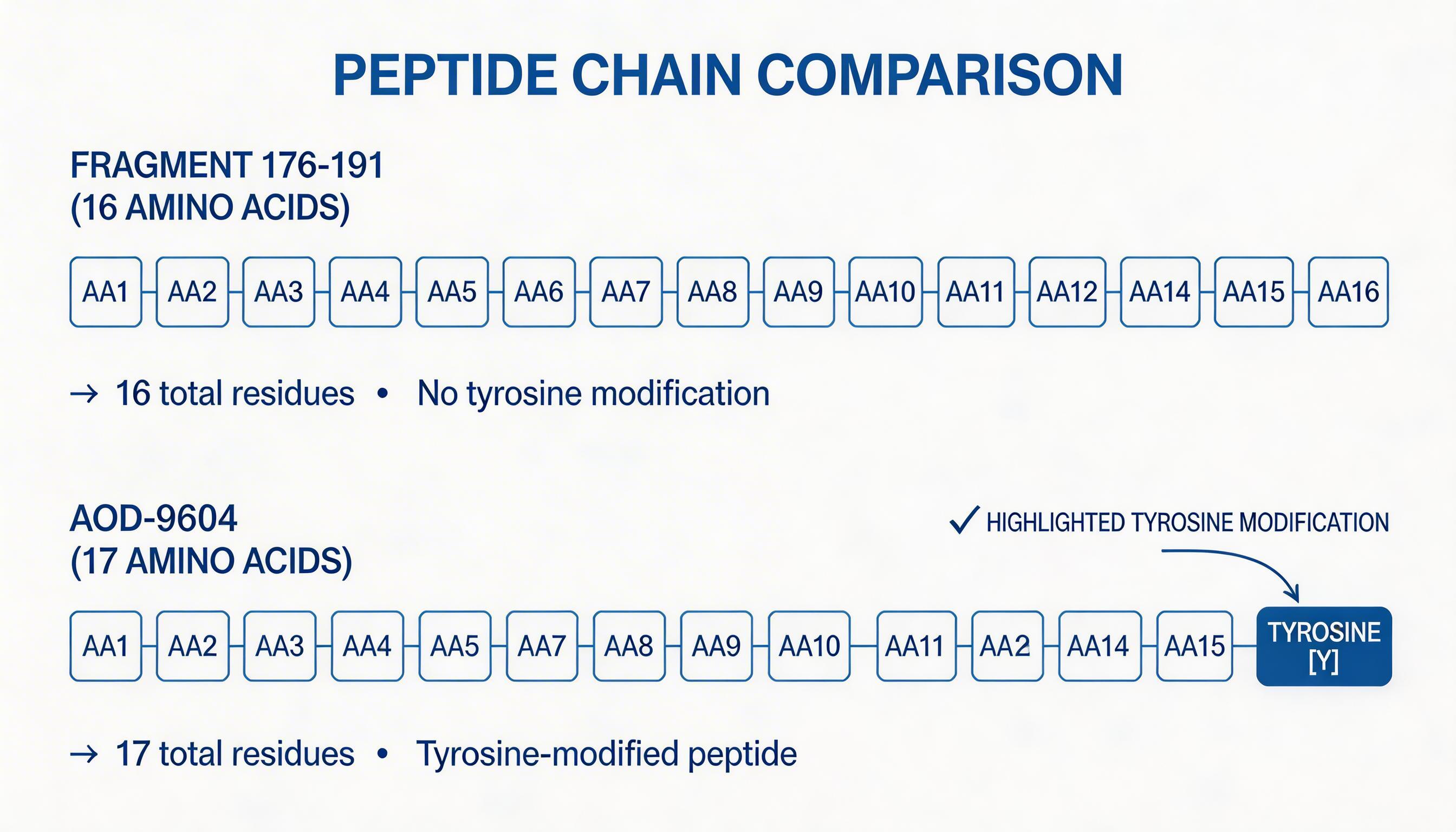
- AOD-9604 = Fragment 176-191 + one extra amino acid (N-terminal tyrosine), making it 17aa vs 16aa
- Both target fat loss via β3-adrenergic lipolysis — zero IGF-1, zero growth effects
- AOD-9604 has a longer half-life and more clinical research; Fragment 176-191 is more widely available
- Dosing is nearly identical: 250–500 mcg/day SC, split AM/PM, fasted
- Do not stack them — they act on the same pathway
- Both are research compounds; not approved for human use in UAE or globally
If you've spent any time researching peptides for fat loss, you've almost certainly encountered both Fragment 176-191 and AOD-9604 — sometimes in the same breath, sometimes as if they're interchangeable. They're not. But they're so closely related that even experienced researchers mix them up.
This guide breaks down exactly what separates these two compounds — at the molecular level and in practice — so UAE researchers can make an informed choice between them.
The Chemistry: One Amino Acid Changes Everything
Both compounds are derived from the C-terminus of human growth hormone (hGH) — specifically the amino acid sequence spanning positions 176 to 191 on the hGH molecule. This 16-residue stretch was identified in the 1990s as the region responsible for hGH's fat-burning effects.
Fragment 176-191 is exactly that stretch: 16 amino acids, molecular weight approximately 1,815 Da, corresponding directly to hGH residues 176–191.
AOD-9604 (Anti-Obesity Drug 9604) was developed by Monash University as a pharmaceutical candidate. Scientists added a single tyrosine (Tyr) residue at the N-terminus of Fragment 176-191, creating a 17-amino acid peptide with a molecular weight of approximately 1,978 Da. This modification wasn't arbitrary — the N-terminal tyrosine was added to:
- Increase resistance to peptidase degradation (longer half-life)
- Improve structural stability in aqueous solution
- Potentially enhance receptor binding affinity
This single modification is the reason AOD-9604 was able to enter human clinical trials in the 2000s. Pharmaceutical-grade stability was a prerequisite for the drug development pathway.
Full Head-to-Head Comparison
| Feature | Fragment 176-191 | AOD-9604 |
|---|---|---|
| Amino acids | 16 (hGH 176–191) | 17 (hGH 176–191 + N-terminal Tyr) |
| Molecular weight | ~1,815 Da | ~1,978 Da |
| Half-life | Short (exact data limited) | Longer — Tyr modification resists degradation |
| Mechanism | β3-adrenergic lipolysis | β3-adrenergic lipolysis |
| IGF-1 effect | None | None |
| Anabolic effect | None | None |
| Human clinical trials | Limited | Phase 2b completed (Metabolicon trial) |
| Oral bioavailability | Very low (SC preferred) | ~40% in animal studies |
| Standard SC dose | 250–500 mcg/day | 250–500 mcg/day |
| Research availability | More widely available globally | Less common, more expensive |
| UAE price (5 mg vial) | AED 200–400 | AED 300–500 |
How Both Work: The β3-Adrenergic Pathway
Despite their structural difference, Fragment 176-191 and AOD-9604 work through exactly the same mechanism — and this is what makes them distinct from full HGH.
Full HGH acts on growth hormone receptors (GHR) and triggers a cascade that includes both fat metabolism (lipolysis) AND anabolic effects (muscle growth, IGF-1 release, bone density, organ growth). The anabolic effects are driven primarily by IGF-1 production in the liver — and are also responsible for most of HGH's side effects.
Both Fragment 176-191 and AOD-9604 bypass the GHR entirely. Instead, they act directly on β3-adrenergic receptors located on adipose (fat) tissue. This activates hormone-sensitive lipase (HSL), the enzyme that breaks down stored triglycerides into free fatty acids — a process called lipolysis.
The result: selective fat breakdown with:
- No IGF-1 elevation
- No insulin resistance
- No glucose disruption
- No effect on muscle protein synthesis
- No organ growth risk
This is the reason both peptides are of significant research interest compared to full HGH — cleaner metabolic profile, fewer variables to control.
Fat Loss Research: Does AOD-9604 Actually Win?
In animal studies, both compounds demonstrate lipolytic activity in obese models. AOD-9604 has a larger body of research, including a 12-week, double-blind, randomised Phase 2b human clinical trial (the "Metabolicon" study). In that trial, oral AOD-9604 (0.25–1 mg/day) produced modest but statistically significant reductions in body weight versus placebo in obese adults.
However, the results were less impressive than hoped, and Monash University halted further pharmaceutical development. The compound never reached Phase 3. This matters because it means there is no gold-standard human efficacy data for either compound — a point often glossed over in research peptide marketing.
Research verdict on fat loss
AOD-9604 has more human data and theoretically better pharmacokinetics due to its longer half-life. Fragment 176-191 is more widely researched in cell and animal models. Neither has completed Phase 3 human trials, and no head-to-head comparison study exists. The practical difference in most research protocols is minimal at equivalent subcutaneous doses.
Dosing Protocol: How They Differ in Practice
The dosing protocols for both peptides are nearly identical in research settings. Both come as lyophilised (freeze-dried) powder in 5 mg vials, reconstituted with bacteriostatic water.
Standard Reconstitution
Add 2 mL bacteriostatic water to a 5 mg vial. This gives a concentration of 2.5 mg/mL (2,500 mcg/mL). Each 0.1 mL (10 units on an insulin syringe) = 250 mcg.
| Protocol element | Fragment 176-191 | AOD-9604 |
|---|---|---|
| Daily dose (research) | 250–500 mcg | 250–500 mcg |
| Injection timing | AM fasted + PM fasted | AM fasted + PM fasted |
| Route | Subcutaneous (SC) | Subcutaneous (SC) |
| Cycle length (research) | 8–12 weeks | 8–12 weeks |
| Oral route | Not viable (very low BA) | ~40% oral BA in animals (not confirmed in humans) |
| Nasal route | Possible; much higher dose needed (~1–2 mg/day) | Less studied nasally |
The fasted state is important for both compounds — research suggests that elevated insulin blunts β3-adrenergic receptor activity, reducing lipolytic signalling. Morning (pre-breakfast) and evening (3+ hours post-meal) injections are standard in the protocols that exist.
Side Effects: Are There Any Differences?
Both compounds have minimal reported side effects in research contexts, and the profiles are essentially identical:
- Injection site reactions — mild redness or transient swelling at the SC injection site; most common adverse effect reported
- No IGF-1 elevation — confirmed in both compounds; eliminates the joint pain, fluid retention, and carpal tunnel syndrome seen with HGH
- No glucose disruption — both have been assessed for insulin sensitivity; neither disrupts fasting glucose in studies
- No androgenic activity — unlike many fat-loss research compounds, neither has any hormonal or androgenic activity
AOD-9604's clinical trial data (the Metabolicon Phase 2b study) confirmed an acceptable tolerability profile over 12 weeks with no serious adverse events. No equivalent human tolerability data exists for Fragment 176-191 in isolation.
Which Should You Choose for Research?
The answer depends on your research priorities:
Choose AOD-9604 if:
- Your protocol requires maximum stability and consistent dosing across a multi-week study
- You want to reference a compound with human clinical trial data
- You are combining with GHRH/GHRP peptides (CJC-1295, Ipamorelin) — AOD-9604 is more commonly used in these stacks in published protocols
- You are running a longer cycle (12+ weeks) where half-life matters
Choose Fragment 176-191 if:
- Budget is a consideration — it is typically AED 100–200 cheaper per vial in UAE
- You want broader supplier availability and more sourcing options
- Your research is focused on basic β3-adrenergic receptor activation without any pharmaceutical-grade modification
- You are comparing against full HGH (Fragment 176-191 is the more "native" sequence)
The bottom line
AOD-9604 is the more developed pharmaceutical candidate with a longer half-life. Fragment 176-191 is more accessible and cheaper. In terms of practical fat loss research outcomes at standard SC doses, the difference is marginal. Do not stack them — they target the same pathway.
UAE Availability and Pricing
Both compounds are available in the UAE as research-grade peptides. Pricing varies by supplier purity and batch certification.
| Compound | Vial size | UAE price range | Notes |
|---|---|---|---|
| Fragment 176-191 | 5 mg | AED 200–400 | More widely stocked; multiple suppliers |
| AOD-9604 | 5 mg | AED 300–500 | Less common; synthesis is more complex |
| Fragment 176-191 | 10 mg | AED 350–600 | Better value for longer cycles |
| AOD-9604 | 10 mg | AED 550–800 | Less frequently available at this size |
When purchasing either compound in the UAE, verify that the supplier provides a Certificate of Analysis (CoA) from a third-party HPLC lab. This confirms purity (should be ≥98% for research-grade) and that the correct compound has been synthesised. Both peptides have similar molecular weights (~1,800–2,000 Da) and can be confused in low-quality supply chains.
The AOD-9604 vs Fragment 176-191 Confusion: Why It Exists
The widespread confusion between these two compounds traces back to how they were originally described in research literature and how supplement companies subsequently marketed them.
In early Monash University publications, AOD-9604 was described as "a modified form of the lipolytic domain of hGH (residues 176–191)." Supplement retailers then began using the terms interchangeably, describing Fragment 176-191 as "essentially AOD-9604" — which is technically backwards (AOD-9604 is the modified version, not the other way around).
Some suppliers have further muddied the waters by selling products labelled "Fragment 176-191 (AOD-9604)" as if they are identical. They are not. If you are purchasing for a specific research protocol, verify the exact amino acid sequence from the manufacturer's Certificate of Analysis.
Research-Grade Fragment 176-191 & AOD-9604 in UAE
CoreSup stocks verified research-grade peptides for UAE researchers. Certificate of Analysis available for all compounds.
View Peptide RangeFrequently Asked Questions
Is AOD-9604 the same as Fragment 176-191?
No — AOD-9604 is a modified version of Fragment 176-191 with an extra N-terminal tyrosine residue (17 amino acids vs 16). They share the same core sequence and mechanism but are distinct compounds with different molecular weights (~1,978 Da vs ~1,815 Da) and half-lives.
Which is better for fat loss — Fragment 176-191 or AOD-9604?
AOD-9604 has a longer half-life and more human clinical data, giving it a theoretical edge. In practice, at equivalent subcutaneous doses, the fat loss difference is minimal. No head-to-head human trial exists to definitively confirm superiority of either compound.
Do either Fragment 176-191 or AOD-9604 raise IGF-1?
Neither compound raises IGF-1. This is their key advantage over full HGH — both selectively target the β3-adrenergic lipolysis pathway without triggering the growth hormone receptor cascade that drives IGF-1 production.
What is the dosage for Fragment 176-191 vs AOD-9604?
Both use nearly identical protocols: 250–500 mcg/day subcutaneous, split into morning and evening injections (both fasted). Reconstitute a 5 mg vial in 2 mL bacteriostatic water (2.5 mg/mL); 0.1 mL = 250 mcg per injection.
Can you stack Fragment 176-191 and AOD-9604 together?
Not recommended — they act on the same receptor pathway (β3-adrenergic lipolysis), so combining them provides no additive benefit. Choose one. AOD-9604 is more commonly combined with CJC-1295 or Ipamorelin in body composition stacks.
Where can I find Fragment 176-191 and AOD-9604 in the UAE?
Both are available as research-grade compounds through UAE peptide suppliers. Fragment 176-191 is more widely stocked (AED 200–400 per 5 mg vial); AOD-9604 is less common and slightly pricier (AED 300–500). Both are sold for research purposes only and are not approved for human therapeutic use.

CoreSup stocks pharmaceutical-grade bacteriostatic water (10ml, 0.9% benzyl alcohol) with same-day delivery across Dubai and all UAE emirates.
Shop Bacteriostatic Water →Shop Featured Products


Related Products


Written by Amir Arsalan
Core Sup Research Team · Peptide & Supplement Specialists, Dubai UAE
Core Sup's editorial team is composed of specialists in peptide therapy, SARMs, and sports supplementation with direct experience in the UAE market. All content is written to current research standards and reviewed before publication.
Last reviewed: March 2026 · About Core Sup


