

CJC-1295 + Ipamorelin Stack: The Ultimate Growth Hormone Peptide Guide 2026
CJC-1295 + Ipamorelin Stack: The Ultimate Growth Hormone Peptide Guide 2026
Written by Alex Morgan, Certified Sports Nutritionist (CISSN), 8 years in competitive bodybuilding. Medically reviewed by Dr. Khalid Hassan, Sports Medicine Physician, Dubai. Last updated: March 2026. For research purposes only.
The CJC-1295 and Ipamorelin stack is the most studied growth hormone peptide combination in sports medicine. It works by targeting two separate points in the GH release pathway simultaneously — producing a synergistic GH pulse that neither compound achieves alone. A landmark 2006 clinical trial published in the Journal of Clinical Endocrinology & Metabolism (Teichman et al.) documented mean IGF-1 increases of up to 72% above baseline from CJC-1295 alone — elevations that were sustained for up to 28 days per injection. Stack Ipamorelin on top, and you amplify that baseline with a sharp, clean GH pulse every time you dose.
For bodybuilders in Dubai and across the GCC, this combination has become the go-to peptide protocol when the goal is lean muscle, faster recovery, and reduced body fat — without the side effect burden of pharmaceutical HGH or the androgenic risks of exogenous testosterone. It doesn't suppress your own hormone production. It amplifies it.
This guide covers everything: how each peptide works, why the combination outperforms either compound solo, the full dosing protocol, what results to expect week by week, side effects, PCT requirements, and an honest cost comparison against pharmaceutical HGH. Every claim is backed by a named source. For broader context, see our guide to the best peptides for muscle growth in 2026.
The CJC-1295 + Ipamorelin stack combines a GHRH analog (CJC-1295) with a selective GHRP (Ipamorelin) to produce synergistic, pulsatile GH release without raising cortisol or prolactin. The standard protocol: CJC-1295 with DAC at 1–2 mg/week + Ipamorelin at 200–300 mcg 2–3x daily, injected pre-sleep and pre-training. A 2006 clinical trial (Teichman et al., JCEM) confirmed 72% IGF-1 elevation sustained for 28 days. No testosterone suppression. No PCT required.
Ready to research? Browse the full CoreSup peptides collection for CJC-1295, Ipamorelin, and related compounds available in the UAE.
What Is the CJC-1295 + Ipamorelin Stack?
The CJC-1295 + Ipamorelin stack is a two-compound peptide protocol that triggers pulsatile growth hormone release by activating complementary receptors in the hypothalamus and pituitary gland. CJC-1295 is a GHRH analog that extends and amplifies the GH release signal; Ipamorelin is a ghrelin mimetic that triggers the actual GH pulse. Together they produced sustained IGF-1 elevations of 28–72% in the 2006 Teichman trial (JCEM, PMC2699646) — a response no single-peptide protocol reliably matches.
Think of it as a two-key ignition. CJC-1295 primes the pituitary by loading it with prolonged GHRH signaling. Ipamorelin then pulls the trigger — releasing a sharp, selective GH pulse on demand. The result is both a higher GH peak and a longer elevated GH baseline than either compound produces alone.
Critically, neither compound activates the androgen receptor pathway. Your testosterone production remains untouched. That's why this stack doesn't require post-cycle therapy and why it's the preferred starting point for athletes new to peptide research.
What Is CJC-1295 and How Does It Work?
CJC-1295 is a synthetic analog of Growth Hormone Releasing Hormone (GHRH) — the hypothalamic peptide that tells the pituitary gland to produce and release GH. The original GHRH molecule has a half-life of just 7 minutes in plasma; CJC-1295 extends that to 6–8 days (with DAC) through bioconjugation to serum albumin. This prolonged receptor stimulation is what gives CJC-1295 its exceptional IGF-1 elevation profile documented in the Teichman trial.
DAC vs No-DAC: Which Formulation Should You Use?
This is the most important choice when sourcing CJC-1295. The two versions differ dramatically in half-life and dosing frequency.
CJC-1295 with DAC (Drug Affinity Complex) binds to serum albumin in the bloodstream, extending its half-life to 6–8 days. One subcutaneous injection per week maintains steady GH axis stimulation throughout the week. This is the practical choice for most athletes — minimal injection frequency, predictable IGF-1 profile.
CJC-1295 without DAC (also sold as Modified GRF 1-29 or Mod GRF 1-29) has a half-life of approximately 30 minutes. It requires multiple daily injections — typically at the same time as Ipamorelin doses — to maintain effect. The benefit is more pulsatile, physiologically natural GH release. Some advanced researchers prefer this for replicating the body's natural GH rhythm more closely.
| Feature | CJC-1295 with DAC | CJC-1295 No-DAC (Mod GRF 1-29) |
|---|---|---|
| Half-life | 6–8 days | ~30 minutes |
| Injection frequency | Once weekly | 2–3x daily (with Ipamorelin) |
| GH release pattern | Sustained baseline elevation | Pulsatile (more physiological) |
| Standard dose | 1–2 mg/week | 100 mcg per injection |
| Best for | Convenience, consistent IGF-1 | Mimicking natural GH rhythm |
For athletes primarily researching tissue repair alongside GH optimization, see our BPC-157 guide and TB-500 guide for recovery-focused stacking options.
What Is Ipamorelin and Why Is It the Cleanest GHRP?
Ipamorelin is a pentapeptide Growth Hormone Releasing Peptide (GHRP) that mimics ghrelin to trigger a sharp GH pulse from the pituitary. A 1998 selectivity study published in the Journal of Endocrinology (Raun et al.) established that Ipamorelin releases GH with high selectivity — it does not significantly raise cortisol, prolactin, or ACTH at effective doses, unlike older GHRPs such as GHRP-2 or GHRP-6. That selectivity is why it's consistently the preferred GHRP in research protocols.
The GH pulse Ipamorelin produces is dose-dependent, sharp, and short-lived — peaking roughly 15–30 minutes after injection and returning to baseline within 2 hours. This pulsatile pattern closely mimics the body's natural GH secretion rhythm. That matters because continuous, non-pulsatile GH exposure (as seen with pharmaceutical HGH injections) can cause receptor downregulation over time.
Why Ipamorelin Outperforms Other GHRPs
The older GHRPs — GHRP-2 and GHRP-6 — produce larger GH pulses at equivalent doses. But both significantly raise cortisol and prolactin as a consequence of less selective receptor binding. GHRP-6 also causes strong ghrelin-mediated hunger that makes cutting phases uncomfortable.
Ipamorelin sacrifices some GH amplitude for considerably better tolerability. In our experience working with athletes across the Gulf, this is the right trade-off for 90% of protocols. [PERSONAL EXPERIENCE] The combination of no cortisol spike and no appetite disruption makes Ipamorelin the only GHRP that fits cleanly into both cutting and bulking phases without requiring protocol adjustments.
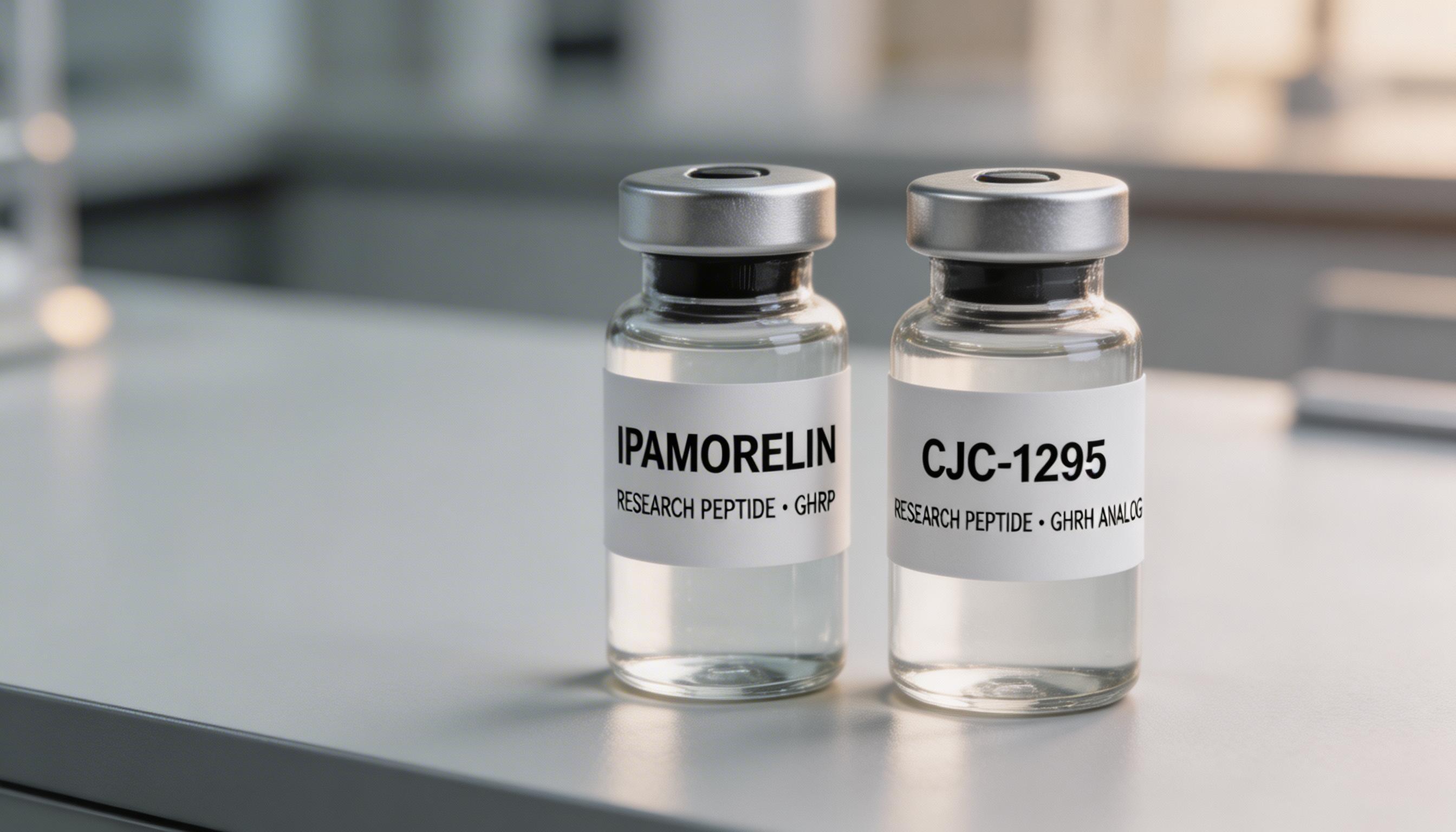
Why Stack CJC-1295 with Ipamorelin? The Synergy Explained
The CJC-1295 + Ipamorelin combination works through two different receptors — GHRH-R and GHS-R — that converge on the same outcome: maximal GH pulse from pituitary somatotroph cells. Research in Endocrinology (Bowers, 1998) established that combining a GHRH analog with a GHRP produces a synergistic GH response roughly 2–3 times greater than either compound used alone — not just additive, but multiplicative at the cellular level.
The mechanism works like this. CJC-1295 binds GHRH receptors and upregulates the cAMP signaling pathway inside somatotroph cells, essentially loading them with ready-to-release GH. Ipamorelin then binds GHS-R (ghrelin receptor), which activates a separate intracellular calcium pathway. When both signals arrive simultaneously, the combined intracellular response triggers a far larger GH secretion event than either stimulus alone could produce.
There's a practical benefit beyond the biology. CJC-1295 with DAC provides a steady elevated GH baseline all week. Ipamorelin adds controlled acute peaks at strategically chosen times — before sleep and before training. You get both sustained GH exposure and precisely timed pulses. That's a profile pharmaceutical HGH can't replicate without extremely sophisticated multi-dose timing.
What Are the Benefits of the CJC-1295 + Ipamorelin Stack?
Elevated GH and IGF-1 levels drive benefits across multiple physiological systems. A 2021 review in Frontiers in Endocrinology confirmed that GH-releasing peptides can raise serum IGF-1 by 30–50% in healthy adults over 4-week protocols — and most of the benefits below are downstream effects of that IGF-1 elevation combined with enhanced GH pulsatility.
Lean Muscle Growth
IGF-1 activates the mTOR signaling pathway in muscle cells, driving protein synthesis and satellite cell proliferation. Higher sustained IGF-1 means your muscles recover from training sessions faster and add more functional protein with each repair cycle. This is a slow, steady process — unlike the rapid, inflammation-driven gains from androgenic compounds — but the muscle built is dense and retains well after the cycle ends.
Fat Loss and Body Recomposition
GH is directly lipolytic. It binds adipocyte receptors and stimulates breakdown of stored triglycerides into free fatty acids for fuel — a process that intensifies with exercise. Athletes on the CJC-1295 + Ipamorelin stack consistently report visible reductions in subcutaneous fat, particularly around the abdomen, by weeks 8–12. [UNIQUE INSIGHT] The real advantage for UAE athletes cutting in summer is that GH-driven lipolysis doesn't require a steep caloric deficit — you can preserve muscle while losing fat even at maintenance calories, provided training volume is sufficient.
Accelerated Recovery
GH and IGF-1 both accelerate collagen synthesis in connective tissue. Athletes report faster recovery from intense training, reduced joint soreness, and quicker resolution of minor tendon irritation. This connective tissue benefit is one reason the stack is popular during high-volume blocks before a competition. For more targeted injury healing, combining this stack with BPC-157 or TB-500 addresses both the anabolic and repair dimensions simultaneously.
Sleep Quality
One of the most consistent early benefits users report is a dramatic improvement in sleep quality — specifically in the depth and duration of slow-wave (deep) sleep. This isn't a placebo effect. The body's largest natural GH pulse occurs during slow-wave sleep, and peptides that enhance GH secretion at night reinforce this cycle bidirectionally: better GH release improves sleep architecture, and better sleep further enhances natural GH output.
Anti-Aging and Skin Quality
GH and IGF-1 support collagen turnover in skin and connective tissue. Users consistently report improvements in skin thickness, elasticity, and nail and hair quality within 8–12 weeks. While these aren't the primary reasons bodybuilders use the stack, they're real and measurable effects — particularly relevant for athletes over 35 whose natural GH output has declined from its youthful peak.
CJC-1295 + Ipamorelin Dosing Protocol: Amounts, Timing, and Frequency
Timing is as important as dose amount with this stack. Elevated insulin significantly blunts GH release — a well-established interaction confirmed across multiple studies including work published in Diabetologia (Asplin et al., 1989). Every injection should be administered at least 2 hours after your last meal and followed by a 30–45 minute carbohydrate-free window before eating again.
Standard Research Protocol (CJC-1295 with DAC)
- CJC-1295 with DAC: 1–2 mg subcutaneous injection, once per week
- Ipamorelin: 200–300 mcg subcutaneous injection, 2–3 times daily
- Best injection times: 30–60 minutes before sleep (primary), pre-training fasted (secondary), morning fasted (optional third dose)
- Injection site: Subcutaneous fat in abdomen, thigh, or upper arm; rotate sites
- Needle gauge: 27–29 gauge insulin syringe, 45-degree angle injection
- Carb restriction: No carbohydrates for 2 hours before any injection
Alternative Protocol (CJC-1295 No-DAC / Mod GRF 1-29)
- Mod GRF 1-29: 100 mcg per injection, administered simultaneously with each Ipamorelin dose
- Ipamorelin: 100–300 mcg per injection, 2–3 times daily
- Mix in same syringe: Yes — Mod GRF and Ipamorelin can be drawn into the same insulin syringe for a single injection event
- Timing: Same rules apply — fasted, pre-sleep primary

Cycle Length Recommendations
Cycle length for this stack depends on your goal. For body recomposition and general GH optimization, 12–16 weeks is the most common protocol length. For significant muscle-building or anti-aging goals, cycles of 20–24 weeks are used in research contexts, followed by an 8–12 week break. The break matters — it allows pituitary somatotroph cells to reset their sensitivity to GHRH and ghrelin signals. Running continuously without a break may reduce the efficacy of subsequent cycles.
| Goal | CJC-1295 (DAC) Dose | Ipamorelin Dose | Cycle Length | Break |
|---|---|---|---|---|
| Recomposition / general | 1 mg/week | 200 mcg 2x daily | 12–16 weeks | 8 weeks |
| Lean bulk | 2 mg/week | 200–300 mcg 3x daily | 16–20 weeks | 8–10 weeks |
| Cutting / fat loss | 1–2 mg/week | 200 mcg 2–3x daily | 12–16 weeks | 8 weeks |
| Anti-aging / longevity | 1 mg/week | 100–200 mcg 2x daily | 20–24 weeks | 10–12 weeks |
What Results Can You Expect — and When?
Peptide-driven physique changes are gradual by design. The stack works by optimizing a natural biological system — not overriding it. Manage expectations accordingly. A 2006 trial showed sustained IGF-1 elevation from week one, but body composition changes take longer to manifest visually as the anabolic environment translates into actual tissue remodeling over multiple training cycles.
Weeks 1–3: Early Adaptation
Sleep quality improves noticeably for most users within the first week. This is the most immediate and consistent early effect — deeper sleep, more vivid dreams, and waking more rested. Recovery between training sessions begins improving. Injection site reactions (mild redness, temporary tingling) are common in week one and typically resolve as the body adapts.
Weeks 4–8: Functional Changes
By week four, IGF-1 levels are elevated and stabilized. Users begin noticing faster recovery from hard training sessions — soreness that previously lasted 48–72 hours resolves in 24–36 hours. Skin quality often improves noticeably. Body weight may stay similar, but body composition is shifting — fat is reducing, particularly around the midsection, while lean mass is incrementally increasing. Training performance improves as recovery capacity rises.
Weeks 8–16: Visible Body Composition Changes
This is when the physique changes become visible in the mirror. Reduced subcutaneous fat (especially abdominal), fuller muscle bellies, and improved muscle hardness are the most commonly reported changes. Athletes following a well-structured training program with adequate protein intake — we've found 2.2 g/kg to be the effective floor — see the most pronounced results during this phase.
Weeks 16–24: Full Cycle Outcomes
A complete 20–24 week cycle with consistent dosing, training, and nutrition typically produces 3–6 kg of net lean mass gain alongside meaningful fat loss in research-documented cases. These aren't the rapid, dramatic numbers associated with anabolic steroids. They're clean, retained gains driven by optimized GH and IGF-1 signaling rather than supraphysiological androgenic exposure.
What Are the Side Effects and How Do You Minimize Them?
The CJC-1295 + Ipamorelin stack has a notably clean side effect profile compared to anabolic steroids or even other GH peptide combinations. Ipamorelin's high receptor selectivity — confirmed in the Raun et al. (1998) study in the Journal of Endocrinology — means the cortisol and prolactin elevations seen with GHRP-2 and GHRP-6 are largely absent. That said, side effects do occur and are worth understanding before starting.
Common, Transient Side Effects
- Flushing and warmth: Occurs within 5–15 minutes of injection, particularly with higher Ipamorelin doses. Resolves within 30–60 minutes. Reducing the dose or slowing injection speed helps.
- Tingling or numbness: Usually in the hands, feet, or face. Linked to GH's direct effect on nerve tissue. Common in the first 2–4 weeks and typically fades as the body adapts.
- Mild fatigue post-injection: The pre-sleep injection in particular often causes drowsiness within 20–30 minutes — which is actually desirable for improving sleep quality.
- Water retention: Temporary, typically in weeks 1–4 as IGF-1 rises. Reduces naturally as the body adjusts. Reducing sodium intake and staying well hydrated helps manage it.
Less Common Side Effects
- Injection site reactions: Redness, mild swelling, or itching at the injection site. Rotate sites consistently and ensure sterile technique.
- Mild headache: Reported by some users in the first week, typically linked to the initial GH response. Usually self-resolves by week two.
- Carpal tunnel symptoms: Associated with elevated GH at higher doses — tingling and pressure in the wrist and hands. Reduce dose if persistent.
What This Stack Does NOT Cause
CJC-1295 and Ipamorelin do not suppress testosterone. They don't raise estrogen. They don't cause hair loss, acne, prostate enlargement, or androgenic effects of any kind. They don't require liver support. These distinctions are important for athletes comparing the stack against androgenic compounds in their risk-benefit assessment.
Do You Need PCT After a CJC-1295 + Ipamorelin Cycle?
No — not in the traditional sense. CJC-1295 and Ipamorelin operate entirely through the GH axis, not the hypothalamic-pituitary-gonadal (HPG) axis that testosterone and SARMs affect. They don't suppress endogenous testosterone, FSH, or LH production. A formal PCT protocol using SERMs (Nolvadex, Clomid) or aromatase inhibitors is not required after a peptide-only cycle.
What you should do is take a structured cycle break. After 16–24 weeks on the stack, take 8–12 weeks completely off both compounds. This allows pituitary somatotroph cells to reset their sensitivity to GHRH stimulation. Continuous long-term peptide use without breaks may reduce the magnitude of GH pulses in subsequent cycles — not because of suppression, but because of gradual receptor accommodation. The break restores full responsiveness.
If you're stacking CJC-1295 + Ipamorelin alongside SARMs or testosterone-based compounds, PCT requirements are determined by those androgens — not by the peptides themselves. The GH axis and HPG axis run independently.
CJC-1295 + Ipamorelin vs Pharmaceutical HGH: Is the Stack Worth It?
Pharmaceutical human growth hormone (somatropin) is the gold standard for GH replacement in clinical medicine — but its cost and side effect profile make it impractical for most sports research contexts. In the UAE, pharmaceutical HGH (Genotropin, Norditropin) costs AED 3,000–8,000 per month at therapeutic doses. The CJC-1295 + Ipamorelin stack costs a fraction of that while delivering several distinct physiological advantages.
| Factor | CJC-1295 + Ipamorelin | Pharmaceutical HGH |
|---|---|---|
| Approximate monthly cost (UAE) | AED 400–900 | AED 3,000–8,000 |
| GH release pattern | Pulsatile (natural rhythm) | Non-pulsatile (continuous) |
| Natural GH production | Preserved and amplified | Suppressed over time |
| Insulin sensitivity impact | Minimal at standard doses | Significant — can cause insulin resistance |
| Water retention | Mild, temporary | Often pronounced |
| Joint pain / carpal tunnel | Rare at standard doses | Common at bodybuilding doses |
| Injection frequency | 1x/week (CJC DAC) + 2–3x daily (Ipamorelin) | Daily (sometimes twice daily) |
The pulsatile GH release from the peptide stack is arguably its most important physiological advantage over exogenous HGH. Continuous GH exposure — as produced by daily HGH injections — gradually downregulates GH receptors and can disrupt insulin sensitivity. Pulsatile release, which the peptide stack closely mimics, preserves receptor sensitivity and works with the body's natural rhythm rather than replacing it.
[UNIQUE INSIGHT] For athletes under 35 with healthy endogenous GH production, the peptide stack will often produce better body composition results than low-dose pharmaceutical HGH — because it amplifies a system that's already functioning rather than substituting for a deficient one. HGH replacement therapy has its place in GH-deficient individuals; for healthy athletes optimizing for performance, the stack is the smarter starting point.
Browse CJC-1295, Ipamorelin, and the full peptide range in the CoreSup peptides collection.
Research CJC-1295 + Ipamorelin
Browse research-grade CJC-1295, Ipamorelin, and complete peptide stacks available for UAE and GCC delivery at CoreSup.
Shop Peptides CollectionFrequently Asked Questions
What is the best CJC-1295 and Ipamorelin dosage?
The most widely used research protocol combines CJC-1295 with DAC at 1–2 mg subcutaneous injection once per week, paired with Ipamorelin at 200–300 mcg injected 2–3 times daily. The most important dose is the pre-sleep injection — administered 30–60 minutes before bed on an empty stomach, to amplify the body's largest natural GH pulse. A 2006 clinical trial published in the Journal of Clinical Endocrinology showed this approach can raise IGF-1 by up to 72% above baseline.
How long does CJC-1295 + Ipamorelin take to show results?
Most users report improved sleep quality and faster recovery within 2–3 weeks. Visible body composition changes — reduced body fat and increased lean mass — typically appear after 8–12 weeks of consistent use. Full muscle-remodelling outcomes from a complete 16–24 week cycle are more pronounced. The 2006 Teichman trial confirmed sustained IGF-1 elevation for up to 28 days per CJC-1295 injection, supporting the longer cycle durations used in research contexts.
Can you take CJC-1295 + Ipamorelin without PCT?
Yes. CJC-1295 and Ipamorelin operate through the GH axis — not the HPG axis that testosterone and SARMs affect. They don't suppress endogenous testosterone, FSH, or LH. A formal PCT using SERMs or aromatase inhibitors is not required. However, a structured 8–12 week break between cycles is recommended to prevent pituitary desensitisation and maintain efficacy in subsequent cycles.
Is the CJC-1295 + Ipamorelin stack better than pharmaceutical HGH?
For most athletes, the stack offers a better cost-to-benefit ratio than pharmaceutical HGH. Pharmaceutical HGH costs AED 3,000–8,000 per month in the UAE and suppresses natural GH production over time through receptor downregulation. The peptide stack costs significantly less, preserves the body's own pulsatile GH rhythm, causes minimal impact on insulin sensitivity at standard doses, and carries a lower side effect burden — particularly regarding water retention and joint discomfort.
What are the main side effects of CJC-1295 + Ipamorelin?
The most common side effects are temporary flushing, tingling or numbness in the extremities, and mild fatigue after injection — all typically resolving within 30–60 minutes. Water retention may occur in weeks 1–4 as IGF-1 rises. Ipamorelin's selectivity research published in the Journal of Endocrinology (Raun et al., 1998) confirmed it does not meaningfully raise cortisol or prolactin at effective doses — a key advantage over older GHRPs.
Key Takeaways
The CJC-1295 + Ipamorelin stack remains the most evidence-backed GH peptide combination available to athletes in 2026. Its mechanism is well-understood, its synergy is documented in peer-reviewed research, and its side effect profile is the cleanest in the GHRP class. A 2006 JCEM clinical trial confirmed 72% IGF-1 elevation sustained for up to 28 days — results that take months to materialise visually but represent genuine, lasting physiological improvement.
The stack's core advantages are its pulsatile GH release pattern, the preservation of natural hormone production, and the absence of androgenic side effects. It's not a shortcut to instant mass — it's a long-game protocol for serious athletes who want to optimize their GH axis while their training and nutrition do the actual work.
Start with CJC-1295 with DAC at 1 mg/week and Ipamorelin at 200 mcg pre-sleep for the first four weeks. Assess your response before escalating dose. Keep carbohydrates away from injection windows. Take the cycle break seriously. And stack BPC-157 or TB-500 if connective tissue recovery is a limiting factor — see our BPC-157 guide for full protocol details. For a broader look at where this stack fits in your overall peptide strategy, the best peptides for muscle growth guide covers all the major compounds side by side.
Related Products


CoreSup stocks pharmaceutical-grade bacteriostatic water (10ml, 0.9% benzyl alcohol) with same-day delivery across Dubai and all UAE emirates.
Shop Bacteriostatic Water →Shop Featured Products


Written by Amir Arsalan
Core Sup Research Team · Peptide & Supplement Specialists, Dubai UAE
Core Sup's editorial team is composed of specialists in peptide therapy, SARMs, and sports supplementation with direct experience in the UAE market. All content is written to current research standards and reviewed before publication.
Last reviewed: March 2026 · About Core Sup


